

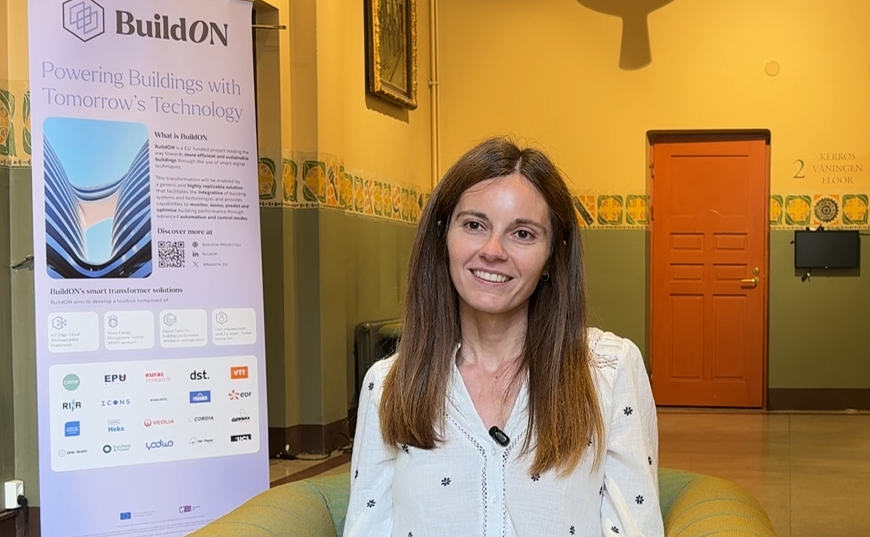
When Sofia Mulero, coordinator of the BuildON project at CARTIF (Valladolid, Spain), talks about smart buildings, she starts from the ground up: people, places, and how technology should adapt to both. “One of the main problems is the involvement of users,” she says. Residential contexts vary widely and, in some cases, “it’s very difficult to reach them through technology.” Offices, kindergartens, small industry—each brings different rhythms, constraints and expectations.
That’s the practical reality BuildON is designed to meet. The project addresses two stubborn barriers in today’s renovation landscape: low user awareness of digital possibilities and fragmented markets where products and systems don’t talk to each other—making it “very difficult to make everything work.”
Rather than asking building owners to rip and replace, BuildON starts by stitching together what’s already there. “We’re going to start with an interoperable framework that mainly wants to address all these challenges,” Sofia explains. On top of this foundation, the team layers digital services “to monitor, assess, predict and optimise building performance,” and digital twins that “simulate and also control… the different systems” so decisions can be tested before they’re applied.
The last mile is human: “To make this more accessible and user‑friendly, we provide a set of tools that interact with all these components… empowering users to make better‑informed decisions.”
Low cost, low disruption
Sofia is clear about the design ethos: “We want to provide very low‑investment sensors, together with actuators and services, [and] the use of artificial intelligence to make these decisions—not very intrusive in buildings.” The aim is to control buildings to make them more efficient and comfortable, reduce energy use, and adapt consumption to the resources available at any given moment.
Because context matters, BuildON “starts in the local context… to understand very well the buildings and the stakeholders that are involved there.” The project then runs training and co‑creation sessions so the people who live and work in these places shape the rollout. That user‑centred process is key to trust—especially in residential blocks with elderly tenants.
What makes BuildON different
Plenty of initiatives stop at dashboards and advice. BuildON goes a step further. “We want to automate this process so that, if the user decides to apply some strategy that is proposed, this can be done automatically.” It’s a quiet shift: instead of asking people to constantly tweak settings, agreed strategies run in the background—and the building does more of the work itself.
What does this mean for everyday life? “At the end of the day they will have lower bills but keep their comfort—even be in better conditions.” Because performance is monitored before and after measures are applied, people can see the difference, not just hear about it.
Standards first, so pilots scale
For Sofia, the path from pilot to policy runs through interoperability and standards. “We hope that our work contributes to standardise solutions in the energy sector… providing interoperable solutions based on standards.” Aligning services with smart‑readiness methodologies helps ensure the results are comparable and replicable across countries and building types.
Sofia is optimistic: solutions like these will soon feel commonplace. As systems connect and automation matures, the promise of smart buildings becomes less about shiny new gadgets and more about quietly better buildings—ones that keep people comfortable, waste less energy, and adapt to changing conditions without fuss.